
- Choose responsibility
- Compare ongoing work
- Price the lifecycle
The development price alone does not establish the cost of running an ordering service.
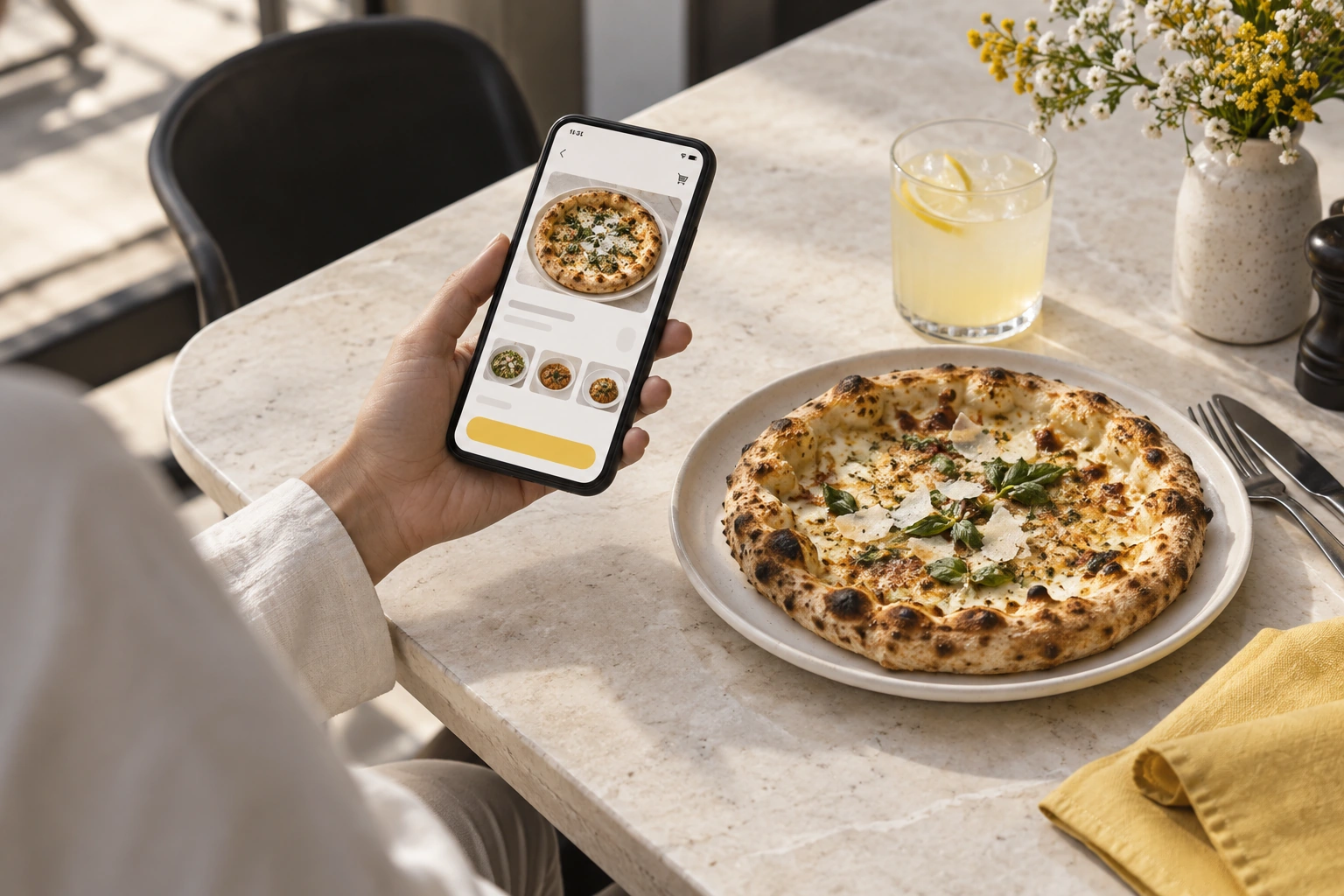
Illustrative decision process, not a product screenshot or customer result.The best online food ordering system is one that supports a restaurant's customer journey and fulfilment process in the proposed configuration. This 2026 research guide separates several product approaches without claiming a universal ranking or verified availability in every country.
Compare the type of solution first
An ordering-led service may focus on the customer website or app. A POS-led service may begin with restaurant operations and add an ordering channel. A custom implementation may offer control but require a maintenance team.
Official sources checked on 10 November 2026 include Restrova, UpMenu, Flipdish and Sapaad.Online. Confirm Pakistan merchant support, payments and contract scope before shortlisting international options.
Score the customer journey
Ask a person unfamiliar with the setup to find an item, choose options and understand the total. Test pickup and delivery separately. Confirm that the customer knows whether the order has been accepted.
An attractive menu is only one part of the journey. An unclear payment response or missing support route can make the whole experience unreliable.
Score the restaurant workflow
| Task | Evidence |
|---|---|
| Receive | Correct order appears in the intended queue |
| Accept | Responsibility and customer message are clear |
| Prepare | Final choices reach the kitchen |
| Handover | Reference connects food with the right customer/rider |
| Review | Staff can explain a correction or cancellation |
Ask for the same test from each supplier. Record unsupported or undemonstrated requirements rather than assuming they work.
Choose with total cost and support in view
Compare setup, software, payment, delivery and maintenance costs for the same scenario. Identify who supports a failure involving several suppliers.
Restrova's pricing is a disclosed minimum-or-percentage model, not a zero-cost or commission-free promise. Use the ordering comparison guide and request a demo with your sample order.
Should a global popularity claim influence the decision?
Only as a reason to investigate, not as proof of fit. Local merchant eligibility, devices, support and the actual restaurant workflow still need verification.
Can a system be best for delivery but unsuitable for dine-in?
Yes. Different service models require different tasks. Define which models are essential before evaluating suppliers.
A practical check: Compare build, hosted and managed ordering approaches
Illustrative scenario: An owner considers building a custom system, subscribing to a platform or outsourcing management. Assign responsibility for updates, incident response and customer support under each option.
- Choose responsibility.
- Compare ongoing work.
- Price the lifecycle.
Decision rule: The development price alone does not establish the cost of running an ordering service.